
Moniteau County Criminal Docket Searches
Start at Missouri Case.net, the statewide portal that covers Moniteau County Circuit Court cases. Enter the full case number if you have it. No number? Search by litigant name instead. Add a first name, and narrow the location to Moniteau County or the 26th Judicial Circuit when that option appears. A filing-date search works well when you know roughly when charges were filed. The Scheduled Hearings & Trials Search answers calendar questions.
Open the matching case number instead of trusting a name match. The Case Header shows the court, filing date, case type, status, and judge. From there, read Docket Entries in order. Check whether a future setting was later continued or reset. The Moniteau County Circuit Clerk maintains the official court docket and case file. So a public record that leaves a document question open can go to the clerk by phone, a courthouse terminal visit, or a narrow written request.
- Open Case.net from the Missouri Courts domain and choose Case Number Search when the notice supplies a complete identifier.
- For an unknown number, use Litigant Name Search and narrow the court location to Moniteau County or the 26th Judicial Circuit.
- Select the case number, then read the Case Header, Docket Entries, and Scheduled Hearings & Trials areas.
- Compare the charge, latest setting, and disposition or sentence entry before drawing a conclusion about the case.
- For a public document or certified record, contact the Circuit Clerk with the case number and the exact item sought.
Case.net for Moniteau Criminal Dockets
Case.net is a search layer over the courts' records, not a separate Moniteau County criminal site. Missouri Court Operating Rule 4 calls for a uniform record system with automated searches by party name, case number, or filing date. Confidential records stay protected under that rule. A public header and docket can appear. This can happen even when a linked document is closed to remote viewing. Per the official Case.net File Viewer help page, a hyperlinked docket entry signals an attached document. But what you can open still depends on that document's security level.
The Missouri eFiling System is something different. It is an authenticated filing and secure-document system, not a substitute for a public Case.net search. When no public image appears online, courthouse staff can provide access at the public terminal. The label E-CASE is worth knowing. It means the case file is electronic rather than paper.
Note: A Track This Case alert helps with monitoring. But Missouri's own materials state it is not the official court record.
Criminal Dockets: What They Show
A Moniteau County criminal docket is a running chronological register. It is not a one-line verdict. Expect public fields such as the case number, court and division, filing date, case style, case type, judge, party roles, charges, and settings. Later judgment or sentence material also appears. The Charges, Judgments & Sentences area lines charges up beside their outcomes. Docket Entries keeps the full sequence of filings, hearings, orders, and post-disposition events in order.
| Case number | A local criminal pattern may appear as YYMT-CR#####; preserve the number from the court notice because historical formats differ. |
|---|---|
| Charge | Public offense text, statute, classification, or charging entry where available. A charge is an allegation until a disposition or judgment states the result. |
| Settings | Date, time, location, judge, and setting type such as arraignment, pretrial, trial, sentencing, or review. |
| Process entries | Complaint, information, indictment, summons, warrant, bond, motion, order, or preliminary-hearing event. |
| Outcome fields | Dismissal, nolle prosequi, plea, verdict, sentence, probation, SIS, or another disposition as stated by the court. |
One docket entry can describe a step without settling anything. Read the newest judgment or signed order together with the full history, especially when an amended charge, a later setting, or an appeal shows up.
Moniteau Criminal Case Numbers
A Moniteau criminal docket number often follows a local pattern. Start with a two-digit year, then the MT county or circuit identifier, a criminal code, and a sequence number, as in 25MT-CR#####. That pattern is a navigation aid, not a guarantee for older cases. Municipal and traffic matters differ. They may carry an MT case-type code or a uniform citation number instead. The number printed on a court notice is always the best one to enter.
The full identifier cuts down on common-name mix-ups. A name search may return several cases. Compare court location, filing date, case type, case style, and number before opening the docket. A missing result can come from a spelling variation, the wrong location, an incomplete number, or a security restriction. It never permits hunting for protected information through some other source.
Criminal Case Stages on the Docket
On a docket, case stages show up as dated events. A case may open with a complaint, information, indictment, or citation. Later entries can cover an initial appearance or arraignment, release activity, and preliminary-hearing or bind-over events on a felony. Pretrial filings, a plea or trial, and the final sentencing or disposition entry follow. Continuances happen. Confirm the newest future setting before relying on it.
Docket flow: Filing or charge → arraignment → preliminary or pretrial setting → plea or trial → disposition → sentencing or post-disposition event.
A disposition is what the court itself says it is: a dismissal, nolle prosequi, guilty plea, guilty verdict, or not-guilty verdict. A probation review or payment entry later on does not erase the original charge. Trust the court's wording. Resist reading a status label as a broader conclusion.
Moniteau Criminal Bond and Capias
A bond line is about process, not guilt. The same goes for recognizance, warrant, capias, and failure-to-appear entries. A bond amount or bond-forfeiture entry shows release or security activity, nothing more. Read a capias or warrant the same way. Check it against later docket activity. Confirm current status with the court or clerk before treating it as a case result.
Old hearings cause similar confusion. When a Moniteau County criminal docket lists a past hearing, look for the later notice of setting, continuance, or reset. That notice controls. Direct confirmation from the Circuit Clerk does too. The chronological record keeps prior events visible after a schedule changes, which is why an older calendar entry can mislead in Moniteau County criminal court dockets.
Moniteau County Criminal Docket Courts
Moniteau County's principal trial court is the Missouri Circuit Court, 26th Judicial Circuit. Criminal and associate divisions fill out the structure. Felony cases begin there with charging and preliminary proceedings. A bind-over entry may show up before felony prosecution. Misdemeanor, municipal, traffic, and ordinance matters can land in associate or municipal divisions. They remain Circuit Court records either way. The Moniteau County Circuit Clerk serves them.
The public records counter sits at the Moniteau County Courthouse, 200 E. Main St., Room 102, California, Missouri 65018, and the phone line is (573) 796-2071. Check the Case Header before anything else. A court setting can carry a different division or case type than a felony, so a docket search should follow the court and division the header lists instead of assuming one path.
Moniteau County Circuit Clerk
200 E. Main St., Room 102
California, MO 65018
(573) 796-2071
Moniteau Municipal Criminal Routes
Where an ordinance case lives depends on the city. California shut down its municipal court effective January 15, 2018. An associate circuit judge of the 26th Judicial Circuit now hears its ordinance violations. Tipton's code takes a different route. It moves the municipal docket and its records into the Moniteau County Circuit Court structure. So a California or Tipton ordinance case belongs in a Case.net search or at the Circuit Clerk. Skip the idea of a city-only archive.
Clarksburg works in a similar way, placing ordinance violations before a Moniteau Circuit Court judge under its code. Jamestown and Lupus show up as municipal reporting entities. Neither offers a separate public docket search. Let the citation, the court location, and the clerk's confirmation identify the right judicial record.
Access Rules for Criminal Dockets
Missouri court-record rules govern what the public can see. Court Operating Rule 2 starts from openness. It presumes judicial records are open for inspection and copying during regular court hours unless a rule, statute, or order closes them. Case.net carries the public index and docket. For anything beyond that, the clerk can say whether a particular document is remotely visible, terminal-only, paper, archived, redacted, or restricted.
Restricted records: RSMo §211.321 generally makes juvenile court proceedings and social records confidential. Under RSMo §610.140, records covered by an expungement order become confidential as the statute provides. Sealed, mental-health, protected-address, and other confidential material may not be available in an ordinary public search.
Missouri's expungement statute governs public access to sealed cases. Its provisions decide when a Moniteau County criminal record closes from view.
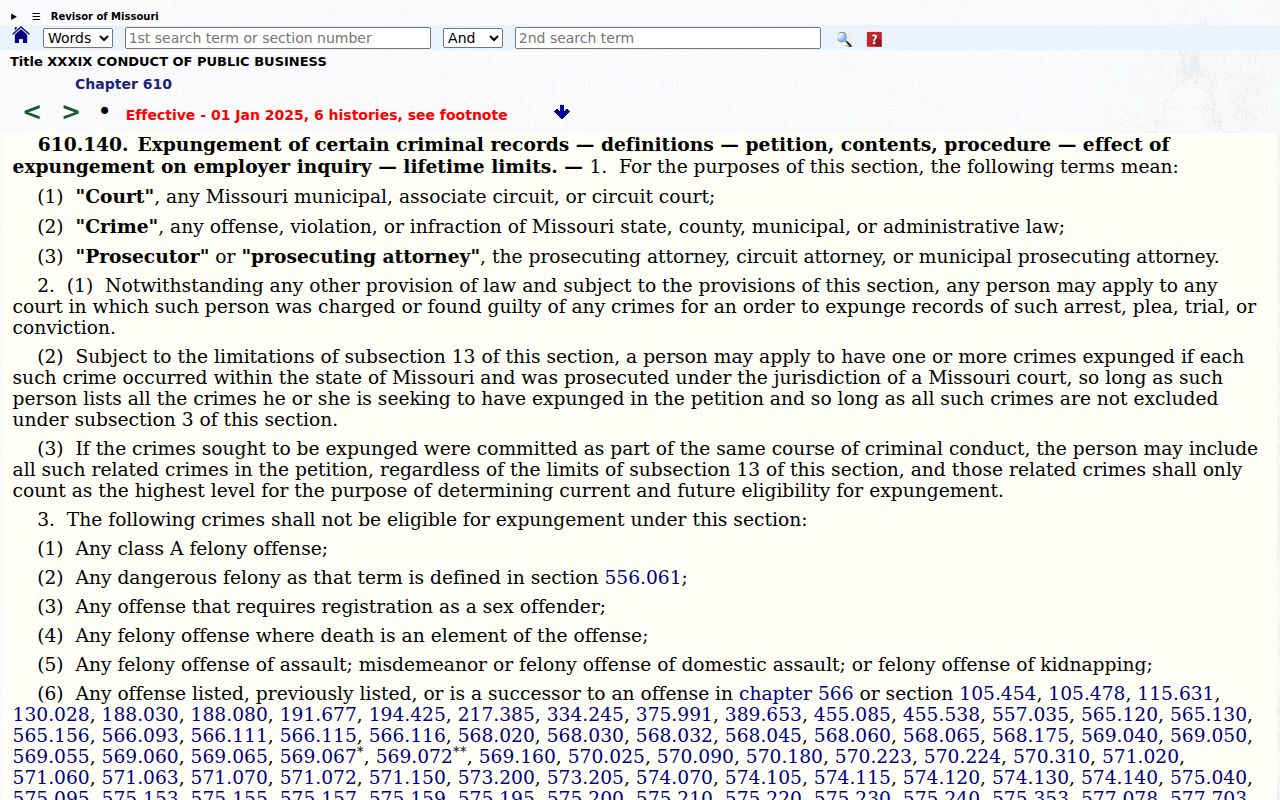
Those confidentiality provisions answer a common puzzle. An expunged criminal docket can drop out of an ordinary Moniteau County public search entirely. The record still exists; the law just shields it.
When a public record is not readily accessible, a narrow written Sunshine Law request can carry the case number, docket subject, document type, date range, preferred format, and whether you want inspection or copies. Keep the request that tight. The clerk can explain the record route, but a public search cannot bypass a security decision.
Moniteau Criminal Terminal Access
Case.net sometimes lists a Moniteau entry but will not show the document. The courthouse itself is the practical fallback. Missouri Court Operating Rule 4 requires courts to provide equipment for electronic access. The public needs it to reach court records and case information online. The state's eFiling guidance puts it simply. Visit the local courthouse and ask staff for the public terminal that opens public electronic files.
Come prepared. Bring the case number. Name the exact docket entry, judgment, or order you need. A specific request moves faster than a vague one. The Circuit Clerk can explain the difference between a plain ordinary copy and a certified copy. The clerk can also quote the current cost of each and say what is available now. Want a transcript? That runs through the official court-reporter route. A sheriff or prosecutor record belongs with that agency, not with the court docket itself.
The official Court Operating Rule 4 recordkeeping material sets out the rules that govern the Moniteau system. These cover the public index, the calendar, and confidential records.
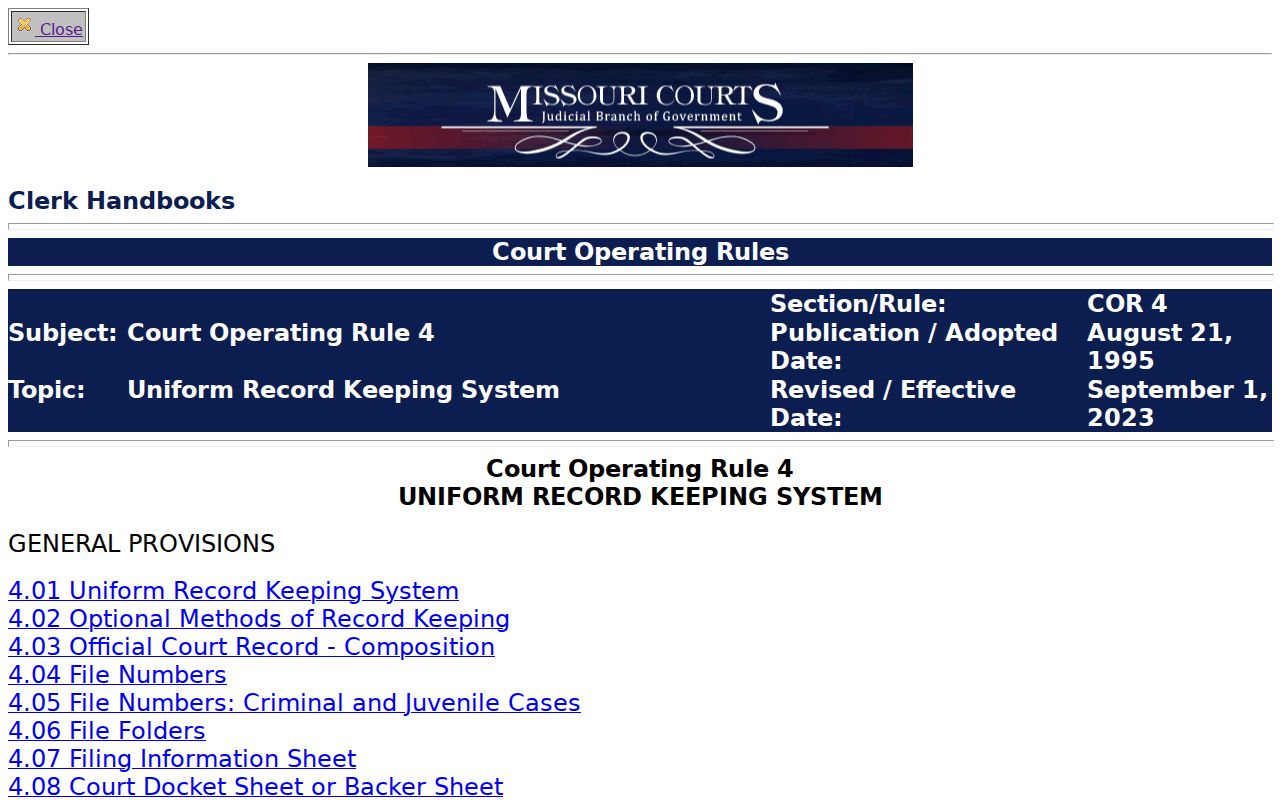
Rule 4 draws the same line both ways. A docket can stay searchable while other records remain confidential or limited.
Moniteau Criminal Docket Terms
Docket terms make more sense in context. Missouri court language rewards that habit. What an entry actually says matters far more than an invented abbreviation or a label borrowed from another county's court docket.
- Arraignment
- A hearing where the accused is advised of the case and enters, or is set to enter, a plea.
- Bind-over
- An entry showing that a felony matter moved after its preliminary stage; later entries may use a related case number.
- Motion
- A request for an order. Filing a motion is not the same as the judge granting it.
- Nolle prosequi
- A prosecutor's ending of a charge or case. Read the disposition entry for the scope and date.
- SIS
- Suspended imposition of sentence, a Missouri disposition term whose effect is defined by the actual court order.
Image source: Missouri Rule 122 access reference.
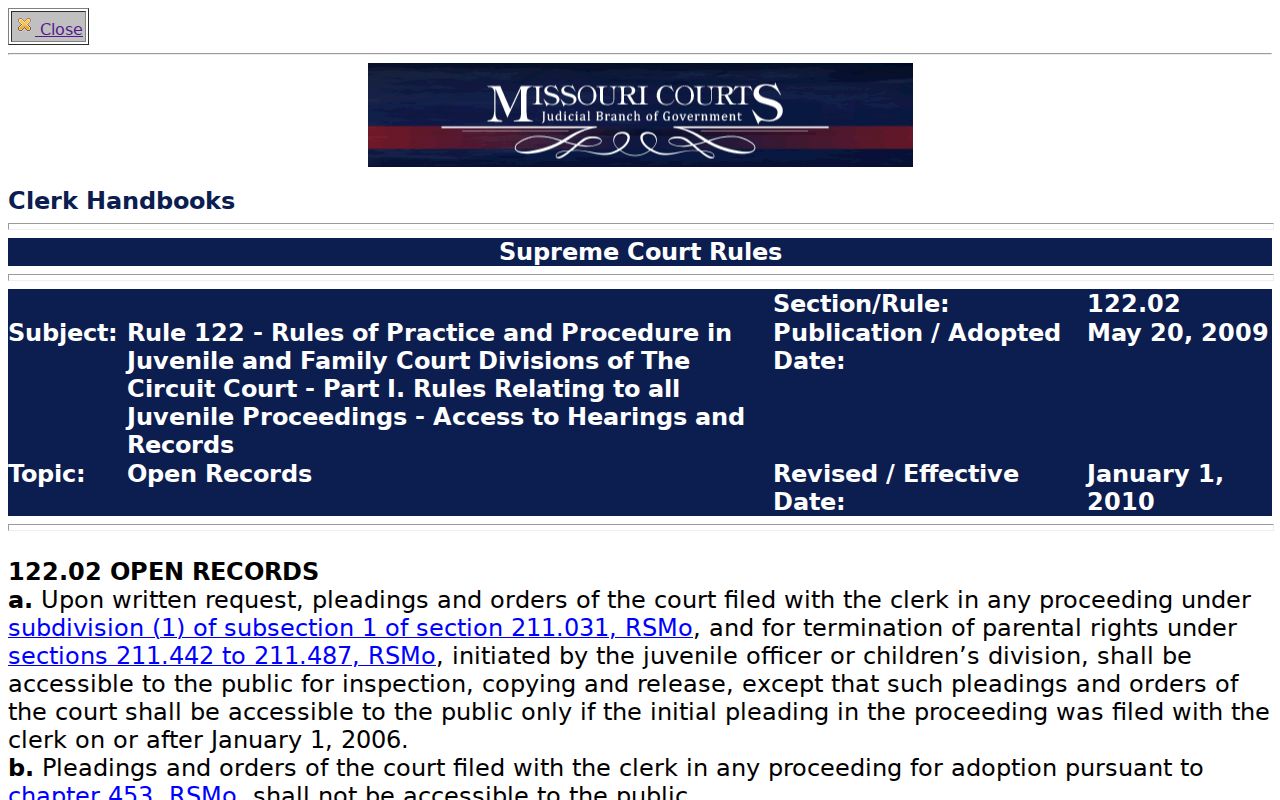
Juvenile records sit in their own confidential category. A missing public criminal result does not mean no court file exists.
Note: The clerk can confirm which public record is available. Only the current docket, notice, or signed order establishes what the court actually did.